
Your desk needs a plant that handles forgotten weekends, dim cubicle light, and two-week business trips without complaint. The best choices, ranked by effort required, are marimo moss balls first, then ZZ plants and snake plants.
Marimo asks for nothing but a water change every one or two weeks and no guesswork about sunlight. It wins because there's no soil to manage, which eliminates most of the ways desk plants fail.
I've spent enough time around desk setups - both as a ModMoss marimo specialist and as someone who's killed more than one succulent - to know that "low maintenance" gets used loosely. Most guides repeat the same seven houseplants without actually defining what makes one easier than another. This ranks eight real options by care effort, not vibes, and includes one category most guides skip: a plant that needs no soil at all.
What Actually Makes a Desk Plant Low-Maintenance?
A desk plant is genuinely low-maintenance when it meets five concrete conditions, not just a vague "it's hardy" label.
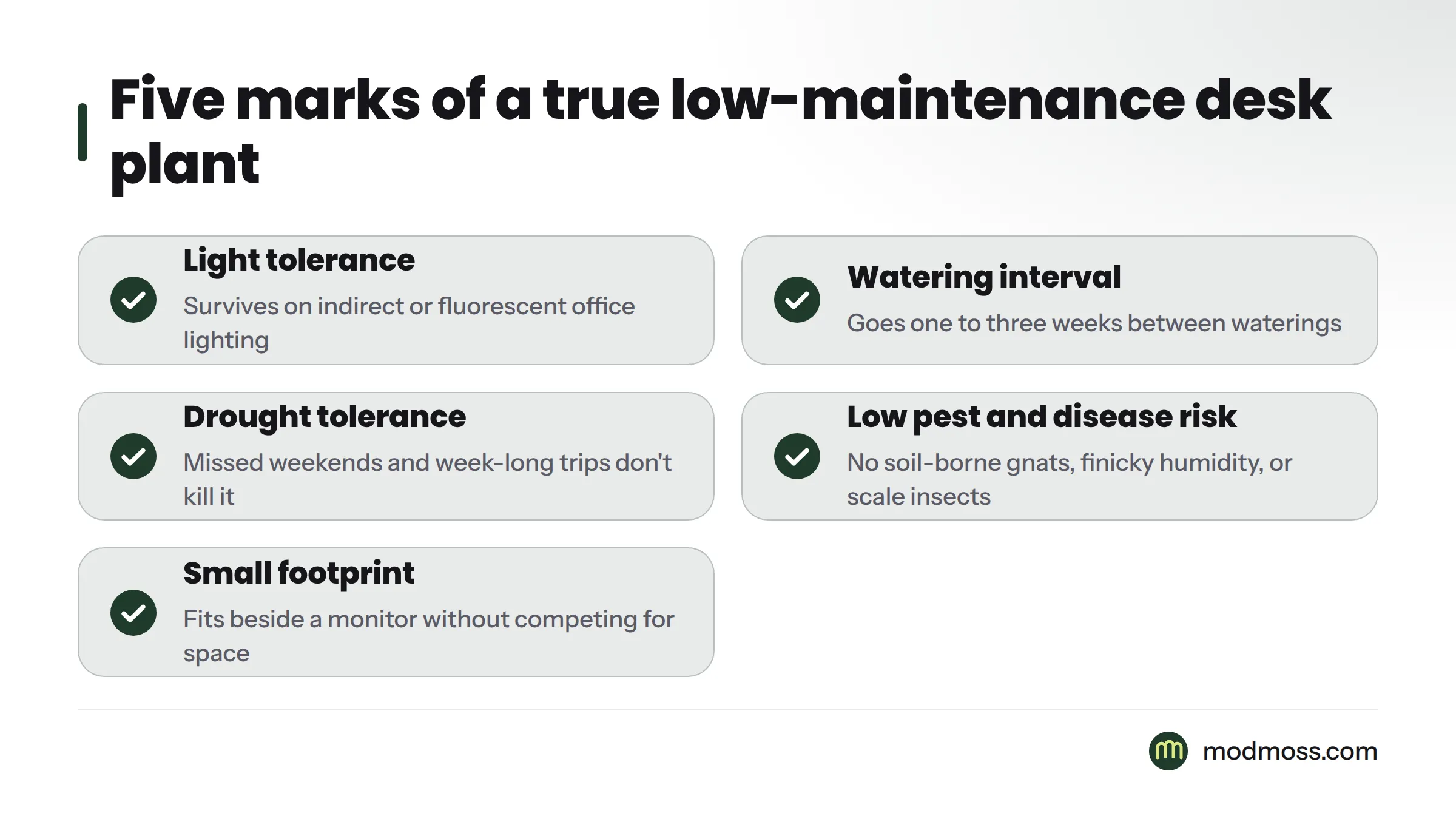
- Light tolerance: It survives on indirect or fluorescent office lighting, not direct sun through a window you may not have.
- Watering interval: It goes one to three weeks (or longer) between waterings without wilting or dying.
- Drought tolerance: Missed weekends and week-long trips don't kill it.
- Low pest and disease risk: No soil-borne gnats, no finicky humidity, no scale insects creeping onto your keyboard.
- Small footprint: It fits beside a monitor or on a shelf without competing for space with your coffee mug and notebook stack.
Before buying, run this quick test.
Three signs a plant will survive your desk:
- The care tag mentions "tolerates low light" or "indirect light" rather than "full sun."
- It's described as drought-tolerant, succulent-leaved, or rhizome-based (meaning it stores its own water).
- It has no soil at all, or soil that's allowed to dry out completely between waterings, so a skipped week won't drown it.
If a plant fails two or more of these checks, it belongs on a windowsill at home, not under office lights.
1. Marimo Moss Ball: The Lowest-Effort Option
Marimo isn't a houseplant in the traditional sense. It's a slow-growing ball of filamentous algae, native to lakes in Japan and Iceland, and it lives in a jar of water instead of soil. That single fact removes almost every failure point that kills desk plants: no soil means no overwatering, no root rot, no gnats, and no drainage tray to manage.
Because marimo photosynthesizes gently and doesn't need direct light to survive, it tolerates dim office lighting far better than almost anything with roots. It also doesn't care whether you work from home three days a week or disappear on a conference trip. Based on feedback from ModMoss kit users, most people change the water every one to two weeks, swirl the ball for a few seconds, and that's the entire routine.
| Attribute | Detail |
|---|---|
| Care effort | 1 (lowest of all 8 picks) |
| Light need | Indirect light, tolerates dim offices |
| Water change | Every 1-2 weeks |
| Desk fit | Small jar or glass vessel, fits beside a monitor |
For a week-by-week care routine, including how water clarity and ball color signal health, see our dedicated guide to marimo care. To add one to your desk, browse marimo moss balls built for small spaces at ModMoss.
2. ZZ Plant
The ZZ plant (Zamioculcas zamiifolia) stores water in thick underground rhizomes, which is why it shrugs off missed waterings better than almost any potted houseplant. Clemson Cooperative Extension notes that ZZ plants tolerate low light and only need watering when soil has dried out completely, making overwatering the bigger risk than neglect. That single trait flips the usual office-plant problem: you're far more likely to kill it by fussing over it than by forgetting it.
Its waxy, dark green leaves handle fluorescent light without stretching or yellowing, which makes it strong for interior cubicles with no window access. Growth is slow, so a ZZ plant can live in the same small pot on a shelf for a year or more before needing repotting.
- Care effort: 2
- Light need: Tolerates low light and fluorescent light; avoid direct sun, which can scorch leaves
- Watering rhythm: Roughly every 2-3 weeks, only once soil is fully dry
- Desk fit: Compact pot, upright growth, good for a shelf or desk corner
3. Snake Plant
Snake plant, now classified botanically as Dracaena trifasciata (formerly Sansevieria), is one of the most drought-tolerant houseplants sold. The Missouri Botanical Garden describes it as adaptable to a wide range of light conditions and notes it should only be watered when soil is completely dry, since it's highly susceptible to rot from overwatering. That drought tolerance comes from thick, succulent-like leaves that store water.
Its upright, sword-shaped leaves take up almost no horizontal space, which makes it ideal for a narrow desk corner or tight shelf where a trailing or bushy plant wouldn't fit.
- Care effort: 2
- Light need: Tolerates low to bright indirect light
- Watering rhythm: Every 2-4 weeks, less in winter
- Desk fit: Narrow, upright footprint, ideal for tight corners
4. Pothos
Pothos (Epipremnum aureum) is recommended for beginners because it tells you exactly what it wants: leaves droop slightly when thirsty and perk back up within hours of watering. The University of Wisconsin-Madison Division of Extension lists pothos as tolerant of low light and irregular watering, noting it's one of the easiest vining houseplants to grow indoors.
One thing competitors gloss over is desk space. Pothos vines trail and lengthen over months, so a plant that starts compact on a shelf can eventually need a clip-in trellis or regular pruning to stay desk-friendly. Pruned vines also propagate easily in a jar of water, so you can keep the plant's footprint in check.
- Care effort: 2
- Light need: Low to medium indirect light
- Watering rhythm: Every 1-2 weeks, when top inch of soil is dry
- Desk fit: Starts compact but trails as it grows; plan for vine space or regular trimming
5. Succulents (Haworthia and Echeveria)
Succulents get recommended constantly for desks, but here's a real light caveat worth flagging: most succulents, including Haworthia and Echeveria, need bright light to stay healthy. A desk that never sees direct or strong indirect sun will leave them stretched and pale over time. North Carolina State University Extension notes that succulents require well-draining soil and infrequent watering, but also that adequate light is non-negotiable for compact, healthy growth.
If your desk sits near a window, Haworthia and Echeveria are genuinely easy, needing water only every two to three weeks. If your desk is deep in an interior office under fluorescent lights only, skip succulents and choose marimo or a ZZ plant instead.
- Care effort: 2 (only if light is adequate; higher effort in dim rooms)
- Light need: Bright indirect to direct light
- Watering rhythm: Every 2-3 weeks, soil must dry fully
- Desk fit: Small pots, great for compact windowsill-adjacent desks
6. Cast Iron Plant
Cast iron plant (Aspidistra elatior) earns its name honestly. The Missouri Botanical Garden lists it as tolerant of deep shade, dust, dry air, and general neglect, a rare combination for a houseplant. It's also one of the slowest growers on this list, meaning you won't be repotting it every year or fighting for desk space as it expands.
The tradeoff is size. Its broad, dark green leaves grow upright and can reach 18 to 24 inches, so it suits a larger desk, a floor spot beside a desk, or an office corner rather than a tight laptop-and-monitor setup.
- Care effort: 2
- Light need: Tolerates low light and deep shade
- Watering rhythm: Every 2-3 weeks
- Desk fit: Larger leaves; best for bigger desks or floor space nearby
7. Spider Plant
Spider plant (Chlorophytum comosum) is forgiving about both light and water, and it gives a visible cue when thirsty: leaf tips curl and the whole plant looks slightly limp before it's in real trouble. Clemson Cooperative Extension notes spider plants adapt to a wide range of indoor light levels and should be watered when the soil surface feels dry to the touch.
Its arching leaves and tendency to send out small plantlets on long stems make it a natural fit for a filing cabinet, shelf, or hanging spot near a desk rather than a flat surface where foliage might droop into your keyboard.
- Care effort: 2
- Light need: Low to bright indirect light
- Watering rhythm: Weekly to every 10 days
- Desk fit: Good for shelves, filing cabinets, or hanging spots near the desk
8. Peace Lily
Peace lily (Spathiphyllum) sits at the higher end of the effort scale on this list, but it earns its spot for one reason: it tells you exactly when it needs water by drooping dramatically, then perking back up within hours of a drink. That built-in signal means you're unlikely to kill it by forgetting, even if the plant looks alarming for a day.
One thing worth knowing before choosing a peace lily for a shared office: the ASPCA lists peace lily as toxic to cats and dogs if chewed or ingested, so it's worth skipping if pets roam the workspace or a coworker brings their dog in on Fridays.
- Care effort: 3 (highest on this list, but self-signaling)
- Light need: Low to medium indirect light; avoid direct sun
- Watering rhythm: Weekly, or whenever it visibly droops
- Desk fit: Medium pot, upright leaves, suits a standard desk corner
- Pet note: Toxic to cats and dogs
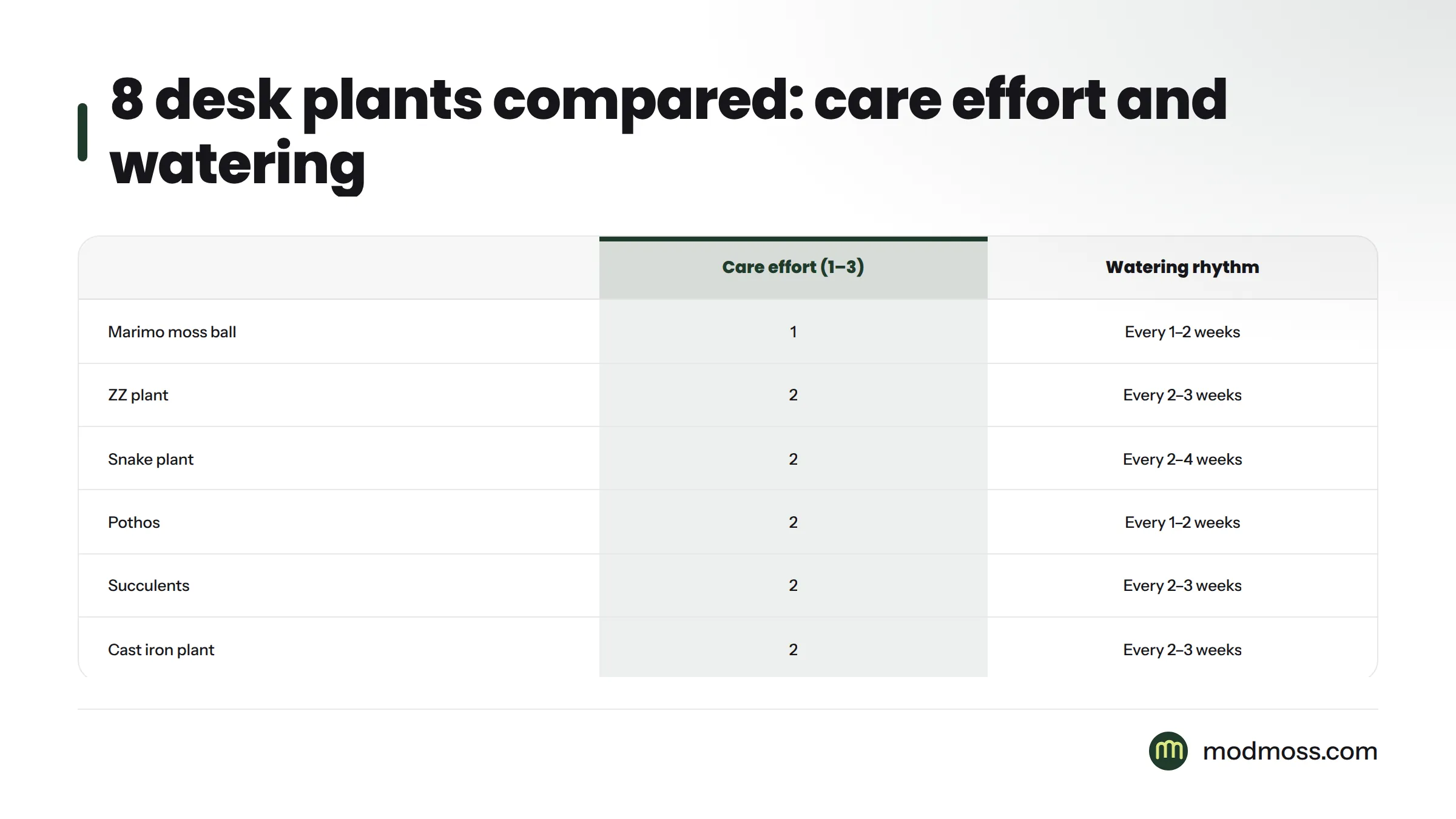
Comparison Table
| Plant | Care Effort (1-5) | Light Need | Watering Rhythm | Desk Fit |
|---|---|---|---|---|
| Marimo moss ball | 1 | Indirect, tolerates dim offices | Water change every 1-2 weeks | Small jar, fits beside a monitor |
| ZZ plant | 2 | Low light to fluorescent | Every 2-3 weeks | Compact pot, upright |
| Snake plant | 2 | Low to bright indirect | Every 2-4 weeks | Narrow, upright, tight corners |
| Pothos | 2 | Low to medium indirect | Every 1-2 weeks | Compact, then trails with growth |
| Succulents (Haworthia, Echeveria) | 2 (needs bright light) | Bright indirect to direct | Every 2-3 weeks | Small pots, windowsill desks |
| Cast iron plant | 2 | Low light, deep shade | Every 2-3 weeks | Larger leaves, bigger desks |
| Spider plant | 2 | Low to bright indirect | Weekly to every 10 days | Shelves, filing cabinets |
| Peace lily | 3 | Low to medium indirect | Weekly or when drooping | Standard desk corner |
Which Plant Matches Your Workspace?
If your desk has no natural window light: Marimo, ZZ plant, cast iron plant, and snake plant all tolerate fluorescent-only environments. Our companion guide on desk plants that cope with low light goes deeper into that scenario if your cubicle sits far from any window.
If you travel often or work from home several days a week: Prioritize marimo, ZZ plant, or snake plant, since all three tolerate two to four weeks of neglect without visible stress.
If your desk is small: A marimo jar or compact Haworthia pot takes up the least real estate. For a larger desk or shared office space, a cast iron plant or trailing pothos on a nearby shelf makes more visual impact.
If pets or small children are in the office: Skip peace lily and choose ZZ plant with care, since ZZ plant sap can irritate skin on contact. Marimo, snake plant, and spider plant are generally considered lower-risk choices, though it's always worth checking with the ASPCA database for your specific pet.
For a broader list beyond desks, our guide to easy houseplants for first-time owners rounds out the options. If you're curious what a plant on your desk actually does for your workday beyond decoration, that's covered separately rather than overstated here. For a different angle on ranking indoor plants worth considering in 2026, this video walks through twenty popular low-care options side by side.
Readers choosing based on workspace style rather than just light and water can also check our breakdown of the best office desk plants by workspace type, which pairs plant choice with desk layout and office culture.
Frequently Asked Questions
What is the easiest plant to keep on a desk? Marimo moss balls are the easiest because they need no soil, no direct light, and only a water change every one to two weeks. Among soil-based options, ZZ plants and snake plants come closest, tolerating low light and weeks between waterings.
Can desk plants survive without sunlight? Yes, several desk plants survive on indirect or fluorescent light alone, including marimo moss balls, ZZ plants, snake plants, and cast iron plants. Direct sunlight isn't required for any of these four, though succulents like Haworthia and Echeveria do need brighter conditions to stay healthy.
How often do low-maintenance desk plants need watering? Most low-maintenance desk plants need water every two to three weeks once soil has fully dried out, while marimo moss balls need a water change roughly every one to two weeks instead of traditional watering. Peace lilies are the exception, often needing water weekly since they wilt visibly when thirsty.
Are marimo moss balls a good desk plant? Marimo moss balls are an excellent desk plant because they require no soil, no drainage, and no direct light, making them nearly impossible to kill through neglect. They only need a water change every one to two weeks, which fits naturally into a busy work schedule.
Start With the Lowest-Risk Choice
If you've killed a few plants already, there's no shame in starting with the one option on this list built to survive exactly that. A desk-sized marimo kit is a low-cost way to test whether you're ready for something with roots, and it looks genuinely good sitting beside a monitor in the meantime. Browse the marimo moss ball collection at ModMoss and pick one sized for your actual desk, not your ambitions, then build up from there if you want to add a ZZ plant or snake plant down the line. For more plant and desk-care guides, visit ModMoss.
Sources
- Clemson Cooperative Extension: ZZ Plant
- Missouri Botanical Garden: Dracaena trifasciata (Snake Plant)
- North Carolina State University Extension: Succulent Plants
- Missouri Botanical Garden: Aspidistra elatior (Cast Iron Plant)
- Clemson Cooperative Extension: Spider Plant
- ASPCA Animal Poison Control Center: Peace Lily