
Picking a glass jar terrarium for a marimo moss ball comes down to four practical things: opening width, vessel height, glass clarity, and base stability. Get those right and almost any shape works - apothecary jars, cylinder vases, bowls, or geo-cut glass. Get them wrong and you end up with a jar that's hard to clean, too dark for the moss ball to stay green, or too unstable on your shelf.
This guide walks through how to think about that choice based on what real ModMoss customers build at home.
What Makes a Glass Terrarium Vessel Right for Marimo?
A marimo moss ball terrarium is water-filled, not soil-based. That distinction matters because most online terrarium content covers closed, planted ecosystems with dirt, charcoal, and tropical plants. A marimo lives in plain water with maybe a few stones at the bottom. It doesn't need drainage layers, humidity control, or special substrate.
What it needs: clear glass, enough room to float and roll, and a container stable enough to sit safely on a shelf.
This simpler job description is exactly why vessel choice feels harder than it should. Without soil layers or planting steps, the whole decision rests on the glass itself - its shape, its opening, and how light passes through it. Marimo are a type of algae, and algae respond to light. The Missouri Botanical Garden notes that algae species regulate their chlorophyll production based on available light, which is why a marimo in deep shade looks duller than one near indirect natural light. A clear jar sized appropriately lets you control that exposure rather than guessing.
Four Criteria to Check Before Choosing a Vessel
Before comparing shapes, weigh these four practical factors. They apply whether you're repurposing a jar from your kitchen or buying one specifically for a moss ball display.
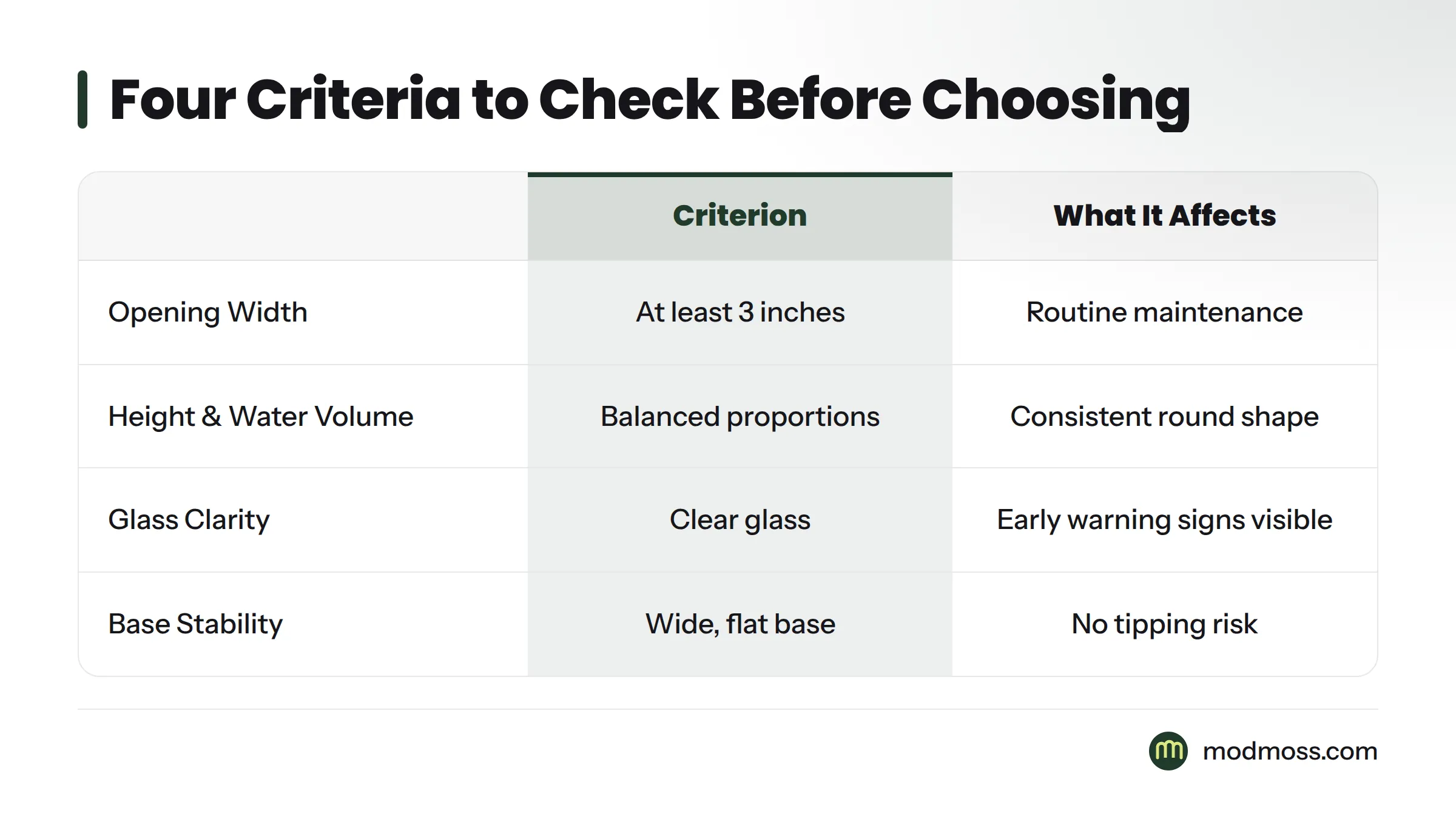
Opening Width: Easy Cleaning and Hand Access
A wide mouth terrarium jar lets you get your whole hand inside to rinse the moss ball, wipe algae film off the glass walls, and refresh the water without struggling to fit the marimo through a narrow neck. Anything narrower than about three inches across makes routine cleaning awkward, especially once the moss ball grows past golf-ball size. If you want to know exactly how often to refresh the water and why, the marimo moss ball care routine walks through that process in detail.
Vessel Height and Water Volume
Height determines how much water surrounds the moss ball and how much room it has to roll and tumble. That natural motion is what keeps a marimo's round shape even on all sides. Too shallow and the ball sits cramped against the glass. Too tall and narrow and you're holding far more water than the moss ball benefits from. For exact pairings between moss ball diameter and jar height, the marimo vessel size chart provides the precise numbers.
Glass Clarity: Seeing What's Happening
Clear glass wins over tinted or heavily frosted glass for one reason: you need to see the water condition and the moss ball's color at a glance. Cloudy water, algae buildup, or browning are early warning signs that a tinted jar hides until the problem becomes harder to fix. Clear glass also lets ambient light pass through evenly, which supports the gentle indirect light marimo prefer. If you love tinted glass, pair it with a bright room rather than a dim corner.
Base Stability: Secure Placement
A jar with a narrow or rounded base looks elegant but tips more easily on a crowded desk or busy shelf. Flat-bottomed vessels with a wider footprint relative to their height are safer anywhere knocks and bumps happen - kids' rooms, office desks, or shelves near a doorway.
Open vs. Closed: Presentation or Convenience
Marimo don't need a sealed environment the way humidity-loving plants do. An open-top bowl or jar is perfectly fine and easier for most people because it allows quick water changes and natural evaporation you can simply top off. A lidded jar can look more finished for gifting, but it isn't doing any functional work for the moss ball itself. Choose closed for presentation, open for convenience. Either keeps a marimo healthy as long as you change the water on a routine.
Before You Buy: 4-Point Checklist
- Opening wide enough to fit your hand or a small brush through
- Height matched to your moss ball's size, with room to roll
- Clear (not heavily tinted) glass so you can monitor water and color
- A base wide enough to stay stable on its intended surface
Popular Glass Vessel Shapes and Their Real-World Trade-Offs
Four shapes appear again and again in marimo displays. Each has a distinct look and distinct practical trade-off.
Apothecary Jars
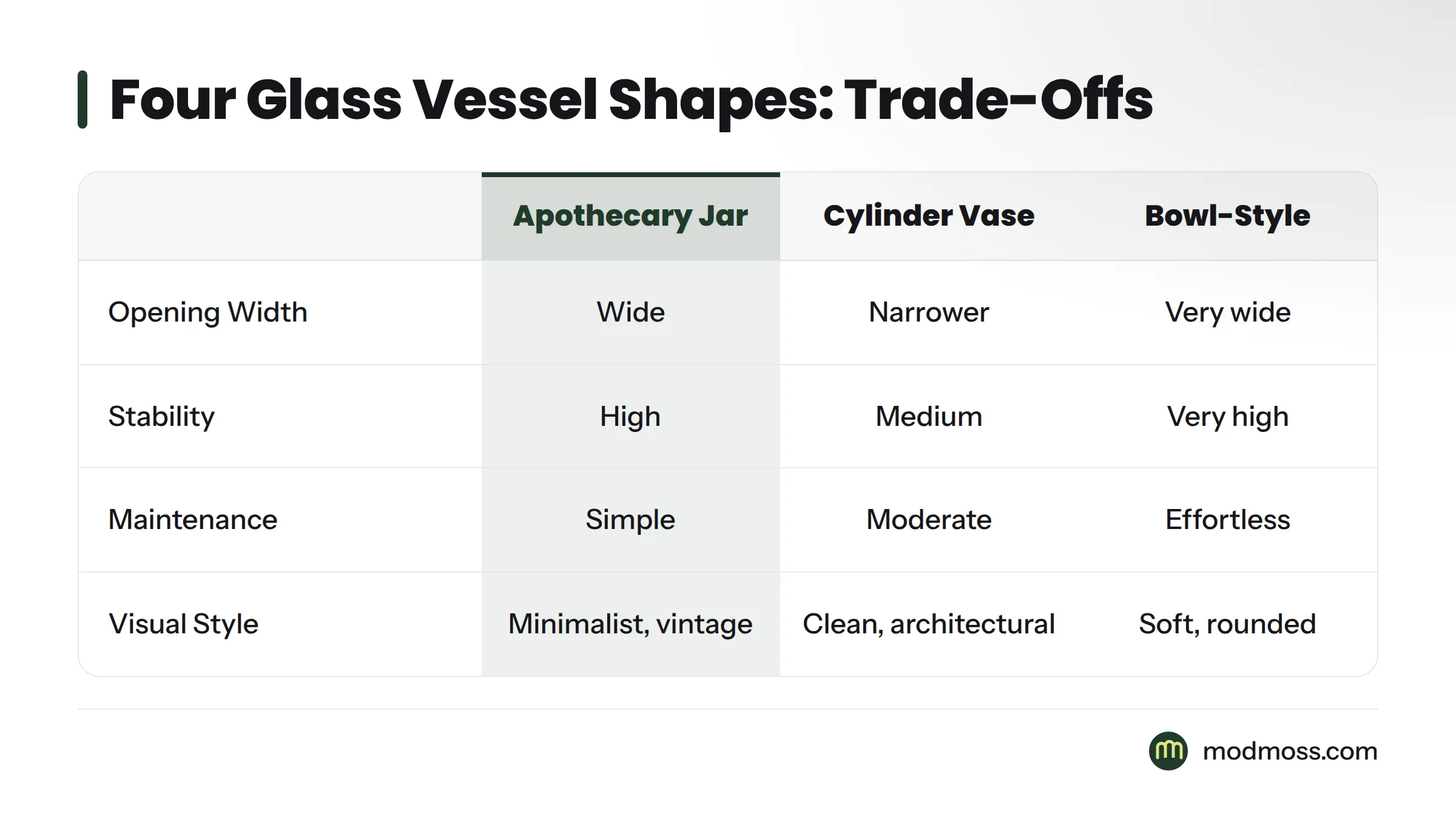
An apothecary jar is a short, wide-mouthed glass container, often with a bulbous body and sometimes a fitted lid, styled after old pharmacy storage jars. For marimo, the wide opening is the real selling point: cleaning and water changes are simple, and the squat shape sits stably on almost any surface. Apothecary jars read as minimalist and vintage, which suits a single moss ball on a desk.
Cylinder Vases
A cylinder vase is a straight-sided, uniformly round vessel with no taper, giving it a clean, architectural look from every angle. Consistent diameter top to bottom means light passes through evenly, and the shape photographs well - which is part of why cylinder vases show up often in gift presentations. The trade-off on taller cylinders is a narrower footprint relative to height, so check stability if the vase will sit near high traffic.
Bowl-Style Vessels
A bowl-style vessel is a low, wide, open-top container with no neck - essentially a flat-bottomed fishbowl. It's the most stable shape on this list by far, and the open top makes maintenance effortless. Bowls suit compact spaces because they don't take up vertical room on a shelf. The look is soft and rounded rather than sharp, which pairs naturally with a single moss ball or a simple two-ball pairing.
Geo-Cut Glass Jars
A geo-cut glass jar is a faceted, geometrically cut vessel built from flat angled panels instead of a smooth curved surface. The facets catch and bend light differently than round glass, creating a dramatic, modern look that reads as a statement piece rather than background decor. Because the cuts can create slight visual distortion at the seams, geo-cut jars suit larger moss ball groupings where the glasswork itself becomes part of the display.
Round vs. Geometric Glass: What to Know
| Factor | Round Glass (apothecary, cylinder, bowl) | Geometric Glass (geo-cut) |
|---|---|---|
| Light behavior | Even, undistorted light throughout | Light refracts at facet edges, creating highlights |
| Visual style | Softer, classic, minimalist | Sharper, modern, statement-making |
| Cleaning | Generally easier, no internal seams | Slightly more effort around facet edges |
| Best for | Everyday desk or shelf display | Shelf centerpieces, gifting a bold look |
Neither is more correct. Round glass is the practical, low-fuss default. Geometric glass is the choice when you want the vessel itself to be part of the design story.
How Many Moss Balls to Pair With Each Vessel Shape
Looking at how ModMoss customers actually pair vessels with moss balls, clear patterns emerge:
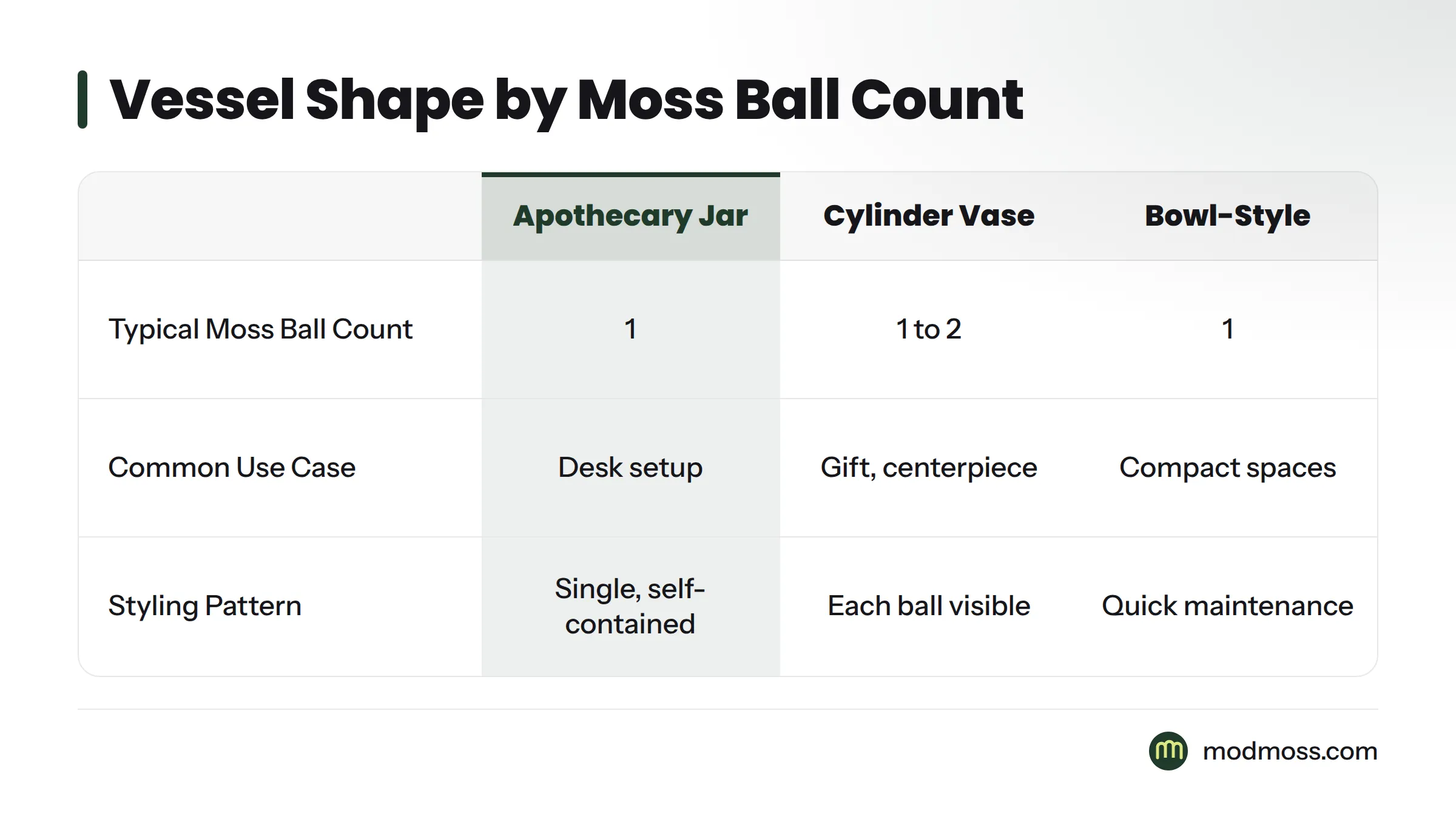
- Apothecary jars are most often paired with a single moss ball, chosen for desk setups where a compact, self-contained look matters.
- Cylinder vases typically hold one or two moss balls, especially when gifted or used as a centerpiece, since straight sides keep each moss ball visible.
- Bowl-style vessels usually house one moss ball, occasionally two in larger bowls, with the open shape favored for quick maintenance over capacity.
- Geo-cut jars are the shape customers most often choose for groupings of two to three moss balls, letting the faceted glass and multiple moss balls read as one larger display.
These are styling patterns, not hard limits. The marimo vessel size chart provides exact diameter and height pairings for your specific moss ball size.
Quick Reference: Vessel Shape by Use Case
| Use Case | Best Vessel Shape | Moss Ball Count | Visual Style |
|---|---|---|---|
| Desk or solo display | Apothecary jar or small bowl | 1 | Minimalist |
| Gift presentation | Cylinder vase | 1 to 2 | Elegant |
| Shelf statement piece | Geo-cut jar | 2 to 3 | Modern |
| Compact spaces | Bowl-style vessel | 1 | Soft, rounded |
Once you've matched a shape to your use case, the fastest way to lock it in is to choose your vessel directly in the kit builder, where you can pair it with the right moss ball size and stones in one pass.
For visual reasoning on what makes a jar workable versus unworkable for a long-term terrarium, this breakdown covers similar ground:
Related Resources
A vessel is just the starting point. Once you've settled on a shape:
- Pick stones to pair with your jar for ballast and visual contrast at the base
- Follow the full walkthrough to assemble the terrarium jar once your vessel and moss ball arrive
- Check the marimo vessel size chart for exact height and diameter pairings
- Browse geometric glass jar options if the faceted look appeals to you
- Review the marimo moss ball care routine so your new vessel stays clear and your moss ball stays round
- If the jar is heading to a desk, the guide to low maintenance desk plants has companion ideas that tolerate the same light conditions
For anyone just getting oriented in vessel selection, exploring options on ModMoss is a good starting point before narrowing down to a single shape.
Frequently Asked Questions
Can I use a mason jar for a marimo terrarium?
Yes. A wide mouth mason jar works well because the opening is generous enough for cleaning and the glass is clear. The main limitation is style - mason jars read as rustic or casual rather than polished, so they suit a kitchen windowsill more than a gift or a design-forward shelf display.
Is a closed or open glass vessel better for marimo moss balls?
Open vessels are generally easier to maintain because water changes and cleaning don't require removing a lid, and marimo don't need the humidity control that closed vessels provide for soil-based plants. A closed, lidded jar still works fine and can look more finished for gifting, as long as you're still opening it to change the water on a routine.
Does the shape of the glass jar affect how my marimo grows?
Shape itself doesn't change how a marimo grows, but it does affect how evenly it tumbles in the water, which is part of what keeps its round form consistent on all sides. A vessel with enough width and height for the moss ball to roll freely supports that shape better than a cramped, narrow container.
How do I know if a glass jar is too small for my marimo?
If the moss ball touches the glass walls on more than one side at rest, or if it can't turn over when the water moves, the vessel is too tight. A good rule of thumb is to leave at least an inch of clearance around the moss ball in every direction, with more space as it grows.
Can I switch vessels later as my moss ball grows?
Yes, and many people do. Marimo grow slowly - often just a few millimeters a year according to horticultural observations - so you won't need to size up often. When you do, transfer the moss ball and its water to a larger jar using the same clarity, stability, and opening-width criteria covered here.
The Bottom Line
Choosing the right glass jar terrarium isn't about finding one "correct" shape. It's about matching opening width, height, clarity, and stability to your space, your moss ball count, and the look you want. Apothecary jars, cylinder vases, bowls, and geo-cut glass all work well. The right one is simply the one that fits what you're building.