
Start with one moss ball per small jar - this rarely disappoints. For larger or wider vessels, add two to four marimo balls, scaling by the jar's width and water volume. Skip the guesswork.
This guide walks you through four concrete steps to size your own jar, so you're not just copying a random forum thread. If you've searched this before, you've probably hit the same walls: scattered forum posts, dead social media links, and anecdotes from strangers about their one overgrown moss ball. None of them show you how to decide for yourself.
This guide fixes that by turning real pairing patterns from ModMoss's kit-builder data into a repeatable framework you can apply to any jar on your desk or windowsill today.
The Quick Answer
Here's the rule in one sentence: a jar under 16 oz (about 470 ml) works best with one marimo, 16 to 32 oz supports a pair, and anything larger than roughly 32 oz (a quart or more) can handle three to four moss balls, assuming the jar is wide enough for them to tumble without constantly bumping into glass or each other.
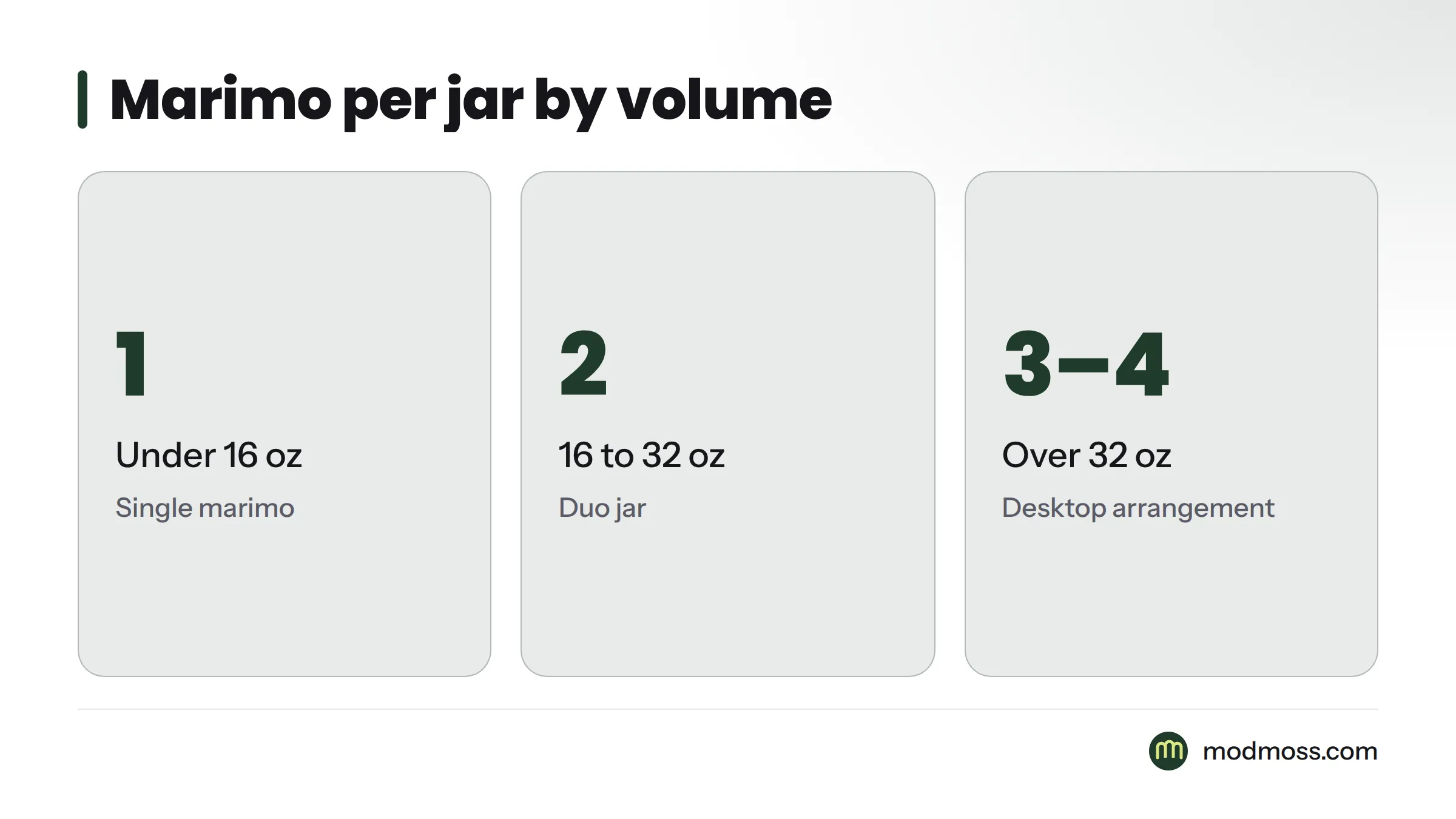
That number comes from matching a marimo ball's need for rolling room and clean, moving water against the actual volume and shape of jars people use at home. A marimo moss ball - scientifically Cladophora aegagropila - is a freshwater algae that grows into a dense, spherical mat and naturally tumbles around its container in the wild. This rolling action keeps its shape even and its surface exposed to light on all sides, according to research from the UW-Madison Center for Limnology. Replicating some of that movement at home is one reason jar size and moss ball count matter more than people expect.
Step 1: Measure Your Jar's Width and Volume
Before you buy moss balls, grab a tape measure or measuring cup and find two numbers: the interior width of the jar at its widest point, and how much water it holds when filled to a comfortable level (not to the brim).
Why width matters more than height
A tall, narrow bud vase might hold 20 ounces, but if it's only two inches across, a single marimo fills it edge to edge. Width is what lets a moss ball tumble and rotate, which keeps its shape even and its entire surface exposed to light. Height just adds water volume without adding rolling space. A short, wide bowl usually works better for multiple marimo than a tall, skinny cylinder holding the same amount.
Ways to measure volume
- Fill the empty jar with tap water and pour it into a measuring cup.
- Check the manufacturer's listed capacity if you bought the jar as a kit or glassware set.
- Use these rough estimates: a standard mason jar is about 16 oz, a typical round fishbowl vase runs 32 to 64 oz, and a small votive-style jar is often under 10 oz.
- When in doubt, round down. You can always add a marimo later.
Step 2: Match Marimo Count to Jar Size
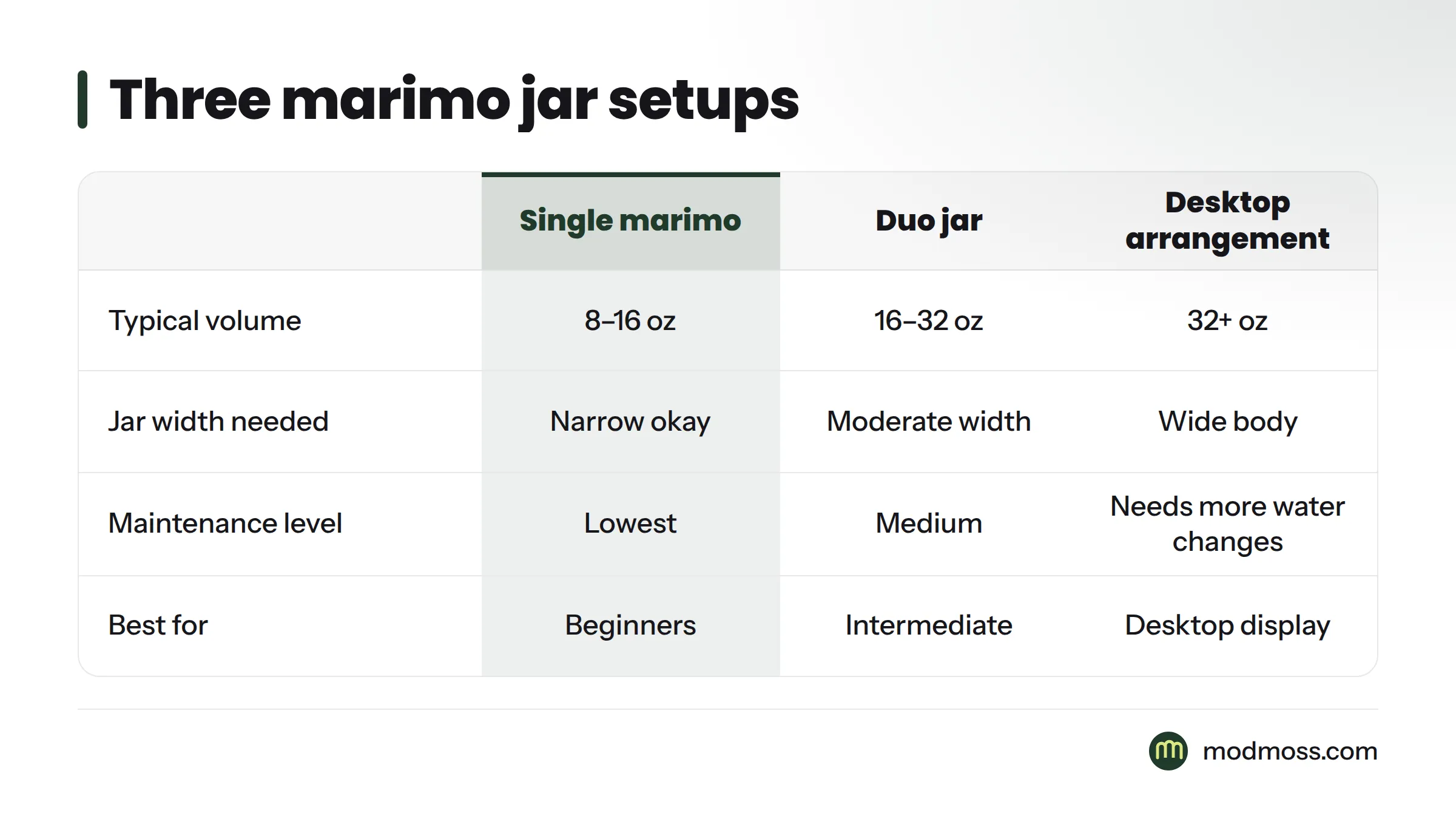
Once you know your jar's width and volume, match it to one of three setups. These are practical categories, not official industry standards.
Single marimo jar
One moss ball in a small, clear jar - typically 8 to 16 oz - is the classic starter setup. It's the most forgiving option for beginners, needs the least water maintenance, and stands alone as a complete display. If you've ever worried that "just one" looks too sparse, it doesn't. A single marimo in the right jar is a design choice, not a shortcut.
Duo jar
A duo jar holds two marimo balls in a 16 to 32 oz vessel wide enough that both can shift position without constantly touching. This works well in slightly wider cylinders or short, round jars and adds visual depth without crowding.
Desktop arrangement (3-4+ balls)
Once you have a jar, bowl, or vase of 32 oz or more with a wide body, three to four marimo balls (sometimes more in a large, open bowl) create a desktop arrangement. This is the look you'll see in multi-ball terrarium displays. Mixing a few different moss ball sizes can look more natural, as long as the container keeps pace with the added volume.
Quick self-check: which category fits your jar?
- Under 16 oz and narrow: single marimo jar
- 16 to 32 oz with moderate width: duo jar
- 32 oz or more and wide-bodied: desktop arrangement
- Tall and narrow regardless of listed volume: treat it as one size category smaller
For more detail on vessel shapes, ModMoss has a guide on choosing the right glass vessel.
Step 3: Account for Growth and Water Movement
Marimo balls grow slowly but steadily. A jar that fits perfectly today can feel tight in a year or two. Leaving breathing room affects water quality and how your moss ball looks over time.
Why space matters for rolling
In their native lake habitat, marimo are shaped by gentle water movement that rotates them so light and nutrients reach the entire surface evenly. In a jar, you won't get that natural current, but giving each ball enough open water to shift position when you rotate the jar by hand prevents one side from staying pressed against glass or another marimo for too long. A ball that never moves can develop a flatter, duller patch where it rests.
How crowding affects water clarity and light
More marimo in the same water volume means more waste building up between changes, since each ball is quietly exchanging gases and shedding debris into a smaller shared space. A crowded jar typically needs more frequent water changes to stay clear. In tightly packed setups, the balls deepest in the jar get less light, which can dull their color over time. None of this is dangerous, but it means the right count depends partly on how often you're willing to change the water, not only on what technically fits.
Step 4: Check Real Pairing Patterns
Theory matters, but real-world patterns are more convincing. Across hundreds of custom orders, ModMoss has tracked which moss ball counts customers actually choose for each vessel size.
What kit-builder data shows
When customers build their own jar through the ModMoss kit builder, a consistent pattern emerges: small jars under a pint overwhelmingly get paired with a single marimo, mid-size jars in the pint-to-quart range are most often built as duo jars, and anything larger tends to get ordered as a three-or-four-ball desktop arrangement. This holds whether the customer is a first-time buyer or someone upgrading an existing setup.
What customers report at each pairing size
Customers who follow this sizing pattern rarely report overcrowding issues. The handful of cases where someone reaches out about cloudy water or a ball that "won't roll anymore" almost always trace back to adding one or two extra balls to a container they already felt was full. That real-world feedback is exactly why this method exists instead of a single flat number.
If you'd rather skip the measuring and start from a tested pairing, pick your moss ball count directly in the kit builder and match it to a vessel in a few clicks.
Quick-Reference Table: Marimo Per Jar by Size
| Vessel type | Typical marimo count | Notes |
|---|---|---|
| Small jar (8-16 oz, narrow) | 1 | Classic single marimo jar; lowest maintenance, beginner-friendly |
| Medium jar or vase (16-32 oz, moderate width) | 2 | Duo jar; needs a wider body, not just more height |
| Large bowl or vase (32+ oz, wide) | 3-4 | Desktop arrangement; mix ball sizes carefully and watch water clarity |
| Tall, narrow vessel (any volume) | 1 fewer than volume suggests | Width limits rolling room more than volume implies |
| Open, no-lid container | Same as size-based count above | No-lid setups don't change count, but may need slightly more frequent top-offs |
Signs You've Added Too Many Marimo
Overcrowding is easy to miss at first because marimo are low-maintenance by nature. Watch for these signs:
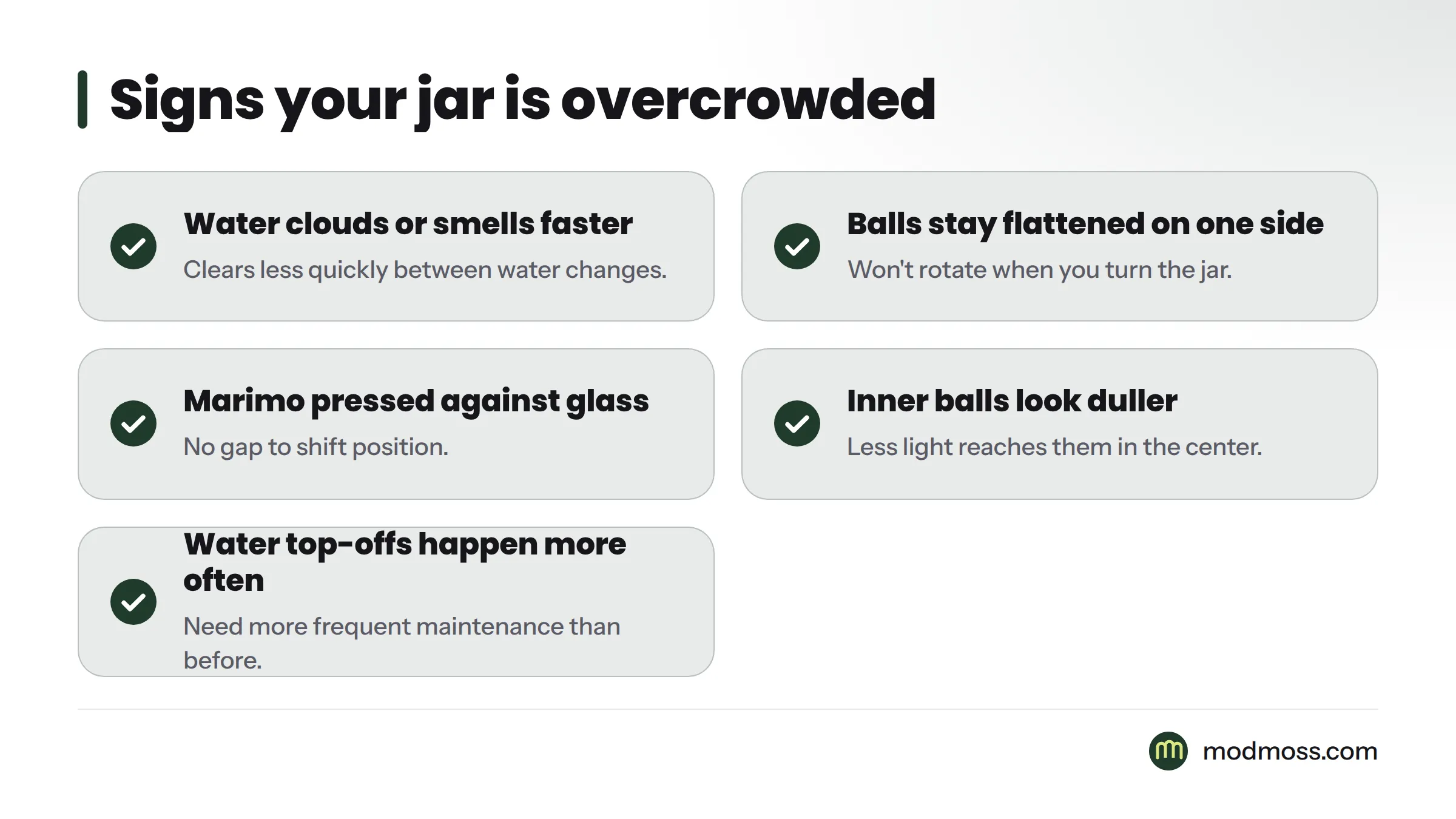
- Water turns cloudy or develops an odor faster than usual between changes
- One or more balls stay flattened on one side instead of rotating when you turn the jar
- Marimo are visibly pressed against the glass or against each other with no gap to shift
- Inner or bottom balls look noticeably duller or darker than those near the light source
- You need to top off or change water significantly more often than before
If you spot two or more of these signs, consider upsizing the jar or splitting the group into two separate containers rather than adding more frequent water changes.
Here's a short video showing what crowding and rolling room actually look like in practice:
Frequently Asked Questions
Can I put just one marimo in a jar?
Yes. A single marimo in a small jar is the most common and most traditional setup, not a lesser option. It's lower maintenance, easier to keep clean, and still a complete display on its own.
What happens if there are too many marimo in a jar?
Water clouds up faster, the balls get less room to rotate and can develop flattened, duller patches, and you'll likely need to change water more often to keep things fresh. This doesn't harm the moss in the short term, but it does mean the jar needs more attention.
Do marimo need space between them?
Ideally, yes - enough space that each ball can shift position without constant contact with the glass or its neighbors. A little crowding occasionally isn't a problem, but balls that are permanently wedged against each other lose some ability to rotate evenly.
How often should I check if my jar is too crowded?
A quick look every time you do a water change is enough. Watch for the signs above (cloudy water, flattened sides, balls that never move) rather than following a strict schedule.
Can I split an overcrowded jar into two separate jars?
Yes, and it's often the simplest fix. Moving one or two marimo into a second small jar instantly solves crowding in both containers and gives you a second desktop display.
For more context on these plants before deciding how many to buy, ModMoss has a piece on what the name "marimo" actually means in Japanese and a weekly care routine guide once your jar is set up. For a broader desk setup, check out the roundup of low-maintenance desk plants that pairs well with a marimo jar.
Ready to Match Your Jar?
You now have a method instead of a guess: measure your jar's width and volume, match it to a single, duo, or desktop category, leave room for rolling and clean water, and check it against real pairing patterns. If you'd rather start with a jar and count already matched for you, ModMoss's full moss ball collection and its desktop marimo garden option are both built around this exact sizing logic, so you can skip the measuring tape and start with a pairing that's already been tested.