
Marimo (まり藻) is a Japanese word meaning "ball algae." The name breaks into two parts: mari (まり), meaning a round bouncing ball, and mo (藻), meaning algae or aquatic weed. Put together, the compound describes exactly what it is: a spherical clump of algae. It's pronounced "mah-ree-moh," not "mare-ee-mo" or anything resembling "marimba."
If you've picked up a marimo at a shop or seen one in a video and wondered what you were actually saying, you're not alone. Let's break down the word piece by piece, sort out the pronunciation, and trace where the name came from.
The Word Broken Down
The short version: mari means "ball," mo means "algae," and together marimo means "ball algae." It's a literal, straightforward name in Japanese - not a metaphor, not a reference to luck or legend.
Here's the breakdown:
- Mari (まり) = a bouncing ball or round toy
- Mo (藻) = algae or aquatic weed
- Marimo (まり藻) = "ball algae," describing the plant's natural spherical shape
All three syllables get roughly equal weight in pronunciation. It's "mah-ree-moh," not "muh-REE-moh" or "MAR-ih-moh."
How the Japanese Words Combine
Japanese compound nouns often stack two meaningful words to describe something new, and marimo is a clean example. Neither word is rare or technical. A Japanese speaker encountering the word for the first time would likely picture a ball made of algae, even without seeing the actual plant.
Mari (まり / 毬) - "Ball"
Mari refers to a ball used in traditional Japanese toys and games. You may have seen temari (手まり), the decorative thread balls wrapped intricately and used in Japanese crafts and children's games. The "mari" in temari is the same root as the "mari" in marimo. It can be written in hiragana (まり) or with the kanji 毬, though hiragana is far more common in everyday use.
Mo (藻) - "Algae" or "Aquatic Weed"
Mo (藻) is a general Japanese term for algae, seaweed, and submerged or floating aquatic plants. It's not specific to marimo. You'll find the same kanji in other Japanese names for water plants, which is a helpful clue: whenever you see 藻 in a Japanese botanical name, it signals something that lives and grows in water.
Why This Pattern Works
Japanese builds new nouns by joining two words in a noun-plus-noun pattern, much like English creates "starfish" or "jellyfish." Marimo follows the same logic: ball (mari) plus algae (mo) equals a word describing the object by what it looks like. There's no hidden meaning or poetic flourish. It's a plain, observational name - and that's exactly why it sounds so natural once you understand both parts.
Pronunciation: Getting It Right
The correct pronunciation is mah-ree-moh, with three even syllables and no stress on any single one. Japanese pronunciation gives each syllable roughly equal timing, which differs from English, where we typically emphasize one syllable over the rest.
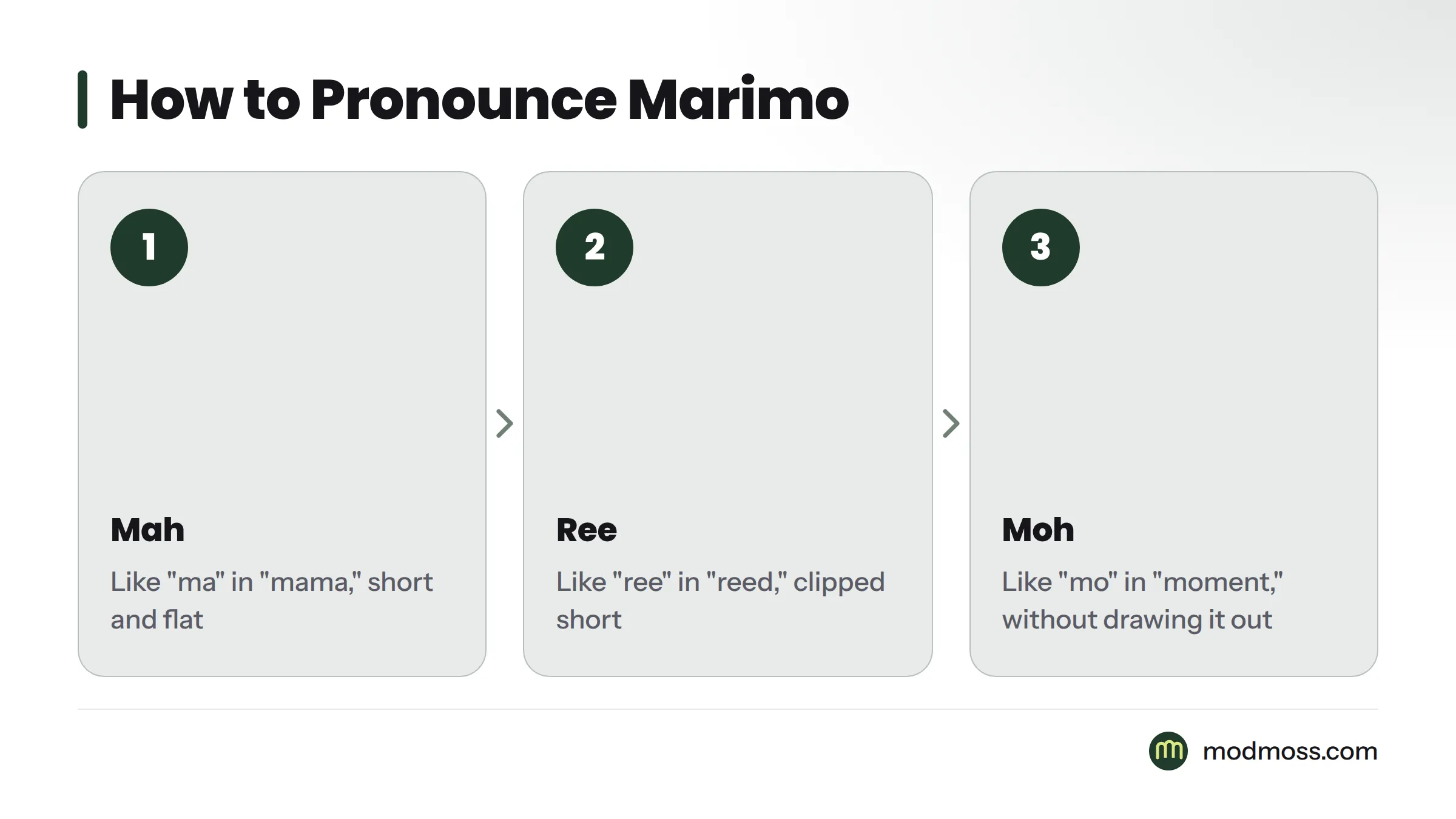
Here's how to say it with confidence:
- Mah - like the "ma" in "mama," short and flat
- Ree - like "ree" in "reed," clipped short
- Moh - like "mo" in "moment," without drawing it out
Say all three at an even pace, without accenting any syllable, and you'll land close to the Japanese pronunciation. This follows standard Hepburn romanization, the most common system for writing Japanese using the Latin alphabet.
Common Mistakes
The ModMoss team hears the same mispronunciations from customers new to these plants. None are "wrong" - Japanese pronunciation isn't intuitive for English speakers - but it helps to know what to listen for.
| What people say | What's happening |
|---|---|
| "Mare-ee-mo" | Stretching the first syllable like the English word "mare" |
| "Mary-mo" | Reading it like the name "Mary" plus "mo" |
| "Muh-REE-mo" | Adding English-style stress to the middle syllable |
| Confusing it with "marimba" | The two words share a similar rhythm and overlapping sounds, but they're unrelated. A marimba is a wooden percussion instrument; marimo is a ball of algae. |
If you've been saying it slightly wrong, you're in good company. The goal isn't to correct you - just to give you the tools to say it the way it's actually meant to sound.
Where the Name Came From
Japanese botanist Takiya Kikunae is credited with coining the term around 1898 after observing round algae formations in Lake Akan, located in Hokkaido, Japan's northernmost main island. Lake Akan remains the most famous location associated with marimo today. The lake's marimo colonies were later designated a natural monument in Japan, a detail that speaks to the plant's cultural standing.
It's worth noting that the indigenous Ainu people of Hokkaido have their own vocabulary connected to moss and aquatic plants, since Lake Akan sits within a region with deep Ainu cultural roots. Some language resources reference a related Ainu-language term associated with "moss." That said, the Japanese word "marimo" as documented through Takiya Kikunae's work is distinct from Ainu vocabulary. The two shouldn't be treated as the same word or as interchangeable, even though they come from the same geographic region.
Ready to explore the plant itself? ModMoss's guide on caring for a moss ball with a weekly routine is a good next step once you've got the name sorted out.
Common Names vs. Scientific Name
The word "marimo" is the common name used in everyday conversation, in Japan and internationally. The scientific name is different and used in formal or academic contexts.
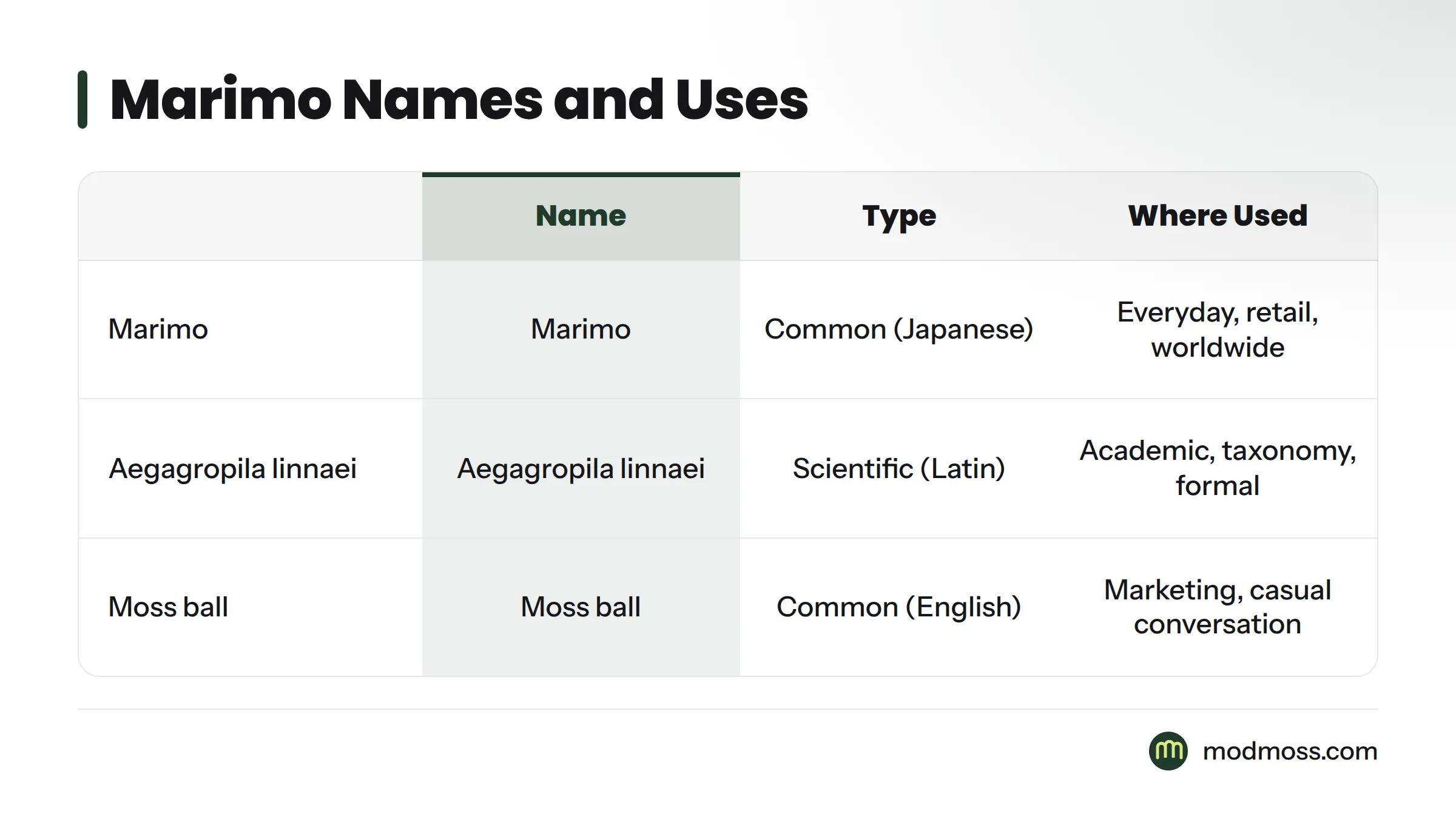
| Name | Type | Where it's used |
|---|---|---|
| Marimo | Common name (Japanese) | Everyday conversation, retail, popular culture worldwide |
| Aegagropila linnaei | Scientific name (Latin binomial) | Scientific literature, taxonomy, botanical classification |
| Moss ball | Common nickname (English) | English-language marketing, casual conversation |
Despite the English nickname, marimo isn't moss at all. It's a freshwater green algae species that grows into a velvety sphere through slow rolling and current movement along a lakebed. The "moss ball" label stuck mostly because of its texture and appearance, not because of any botanical relationship to actual moss.
What the Name Does Not Mean
This is worth stating plainly: the word "marimo" is purely descriptive. It tells you the plant is ball-shaped algae. It does not contain meaning about luck, fortune, romance, or symbolism. Those associations exist in Japanese culture, but they come from folklore and tradition built up around the plant over time, not from the name's literal translation.
If you're curious about marimo as a symbol of good luck or the legend tied to Lake Akan, those are genuinely interesting topics - just not what this word-by-word breakdown answers. The name itself is simple and honest: ball algae. Nothing more.
Quick Reference
Marimo means "ball algae" in Japanese, built from mari (ball) and mo (algae), pronounced "mah-ree-moh" with even emphasis. It's a common name credited to botanist Takiya Kikunae around 1898, tied to the colonies at Lake Akan in Hokkaido, and it's distinct from the plant's scientific name, Aegagropila linnaei.
If you're bringing a marimo into your space for the first time, ModMoss's homepage is a good place to see the moss balls themselves and get a feel for what the name has been describing all along. For setup ideas, the guide on choosing the right glass vessel and the roundup of low maintenance desk plants are both useful if you're deciding where your new marimo should live.
Frequently Asked Questions
What does the word "marimo" literally mean? It means "ball algae." Mari means ball, mo means algae, and the two combine into a direct, descriptive Japanese compound word.
Is marimo a Japanese word? Yes. It's a native Japanese term, written まり藻 or marimo in romanized form, and it's the common name used both in Japan and internationally.
How do you pronounce marimo? Say it "mah-ree-moh," with three even syllables and no heavy stress on any one part, following standard Hepburn romanization for Japanese words.
What is the difference between marimo and its scientific name? "Marimo" is the common name. The scientific name is Aegagropila linnaei, a Latin binomial used in botanical and scientific contexts. "Moss ball" is a separate English nickname, not a scientific term.
Who named marimo, and when? The name is credited to Japanese botanist Takiya Kikunae, who coined the term around 1898 in connection with his observations of the algae growing in Lake Akan, Hokkaido.
Does "marimo" mean "lucky"? No. The word itself is purely descriptive and translates to "ball algae." Good luck symbolism is a separate cultural belief that developed around the plant over time, not something contained in the translation of the name.
Is marimo related to the Ainu word for moss? Not directly. There is a related term in Ainu vocabulary connected to moss, and Lake Akan sits in a region with strong Ainu cultural history, but the Japanese word "marimo" as documented through Takiya Kikunae's naming is a distinct term, not an Ainu loanword.